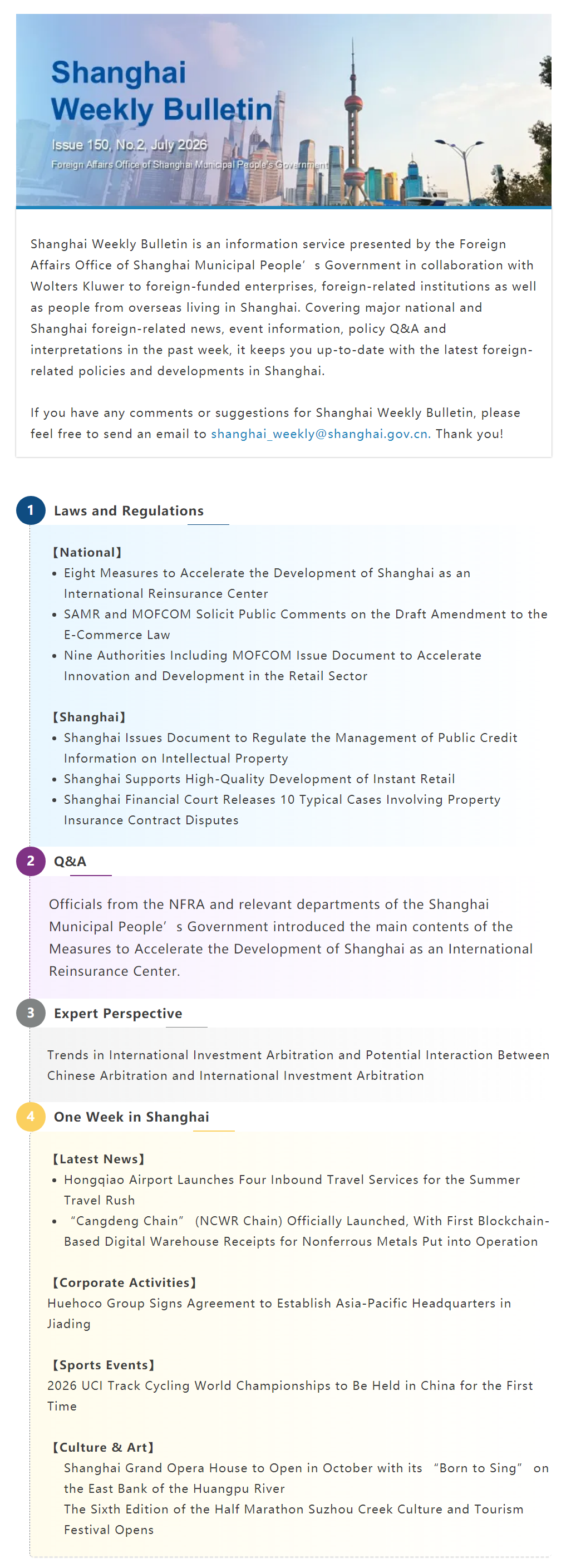
Shanghai Weekly Bulletin (Issue 150 No.2, July 2026) ( 2026.07.15 )
Laws and Regulations
National
1. Eight Measures to Accelerate the Development of Shanghai as an International Reinsurance Center
[Keywords: Shanghai International Reinsurance Center]
The National Financial Regulatory Administration (NFRA) and the Shanghai Municipal People’s Government recently issued the Measures to Accelerate the Development of Shanghai as an International Reinsurance Center. The document sets out eight measures, namely, guiding institutional development, improving unified registration, accelerating platform development, strengthening capacity supply, deepening reform and opening-up, expanding cross-border cooperation, enhancing regulatory effectiveness, and fostering a better development environment.
Source: NFRA
https://www.nfra.gov.cn/cn/view/pages/ItemDetail.html?docId=1263701&itemId=928&sessionid=
2. SAMR and MOFCOM Solicit Public Comments on the Draft Amendment to the E-Commerce Law
[Keywords: E-Commerce Law]
The State Administration for Market Regulation (SAMR) and the Ministry of Commerce (MOFCOM) recently issued a notice soliciting public comments on the Draft Amendment to the E-Commerce Law of the People’s Republic of China. The document mainly covers revisions in five areas, including expanding the scope of the law, improving the platform responsibility system, and clarifying the coordination mechanism for regulatory authorities. The deadline for feedback is August 4, 2026.
Source: SAMR
https://www.samr.gov.cn/hd/zjdc/art/2026/art_41b16f1123ee4cd7acf892bb8bed5fe0.html
3. Nine Authorities Including MOFCOM Issue Document to Accelerate Innovation and Development in the Retail Sector
[Keywords: Retail sector]
The MOFCOM and eight other authorities recently issued the Opinions on Accelerating Innovation and Development in the Retail Sector. The document sets out measures in six areas: systematically planning new layouts, leading new retail supply, creating new consumer demand, stimulating new growth drivers for retail, fostering a new competitive environment, and strengthening supporting policies.
Source: MOFCOM
https://www.mofcom.gov.cn/zwgk/zcfb/art/2026/art_3e1e591d9e994c43a7618e1e31c734be.html
Shanghai
1. Shanghai Issues Document to Regulate the Management of Public Credit Information on Intellectual Property
[Keywords: Intellectual property, Public credit information]
Recently, the Shanghai Intellectual Property Administration and the Shanghai Administration for Market Regulation issued the Interim Measures of Shanghai Municipality for the Management of Public Credit Information on Intellectual Property. The document clarifies the scope of public credit information and information on untrustworthy conduct in the field of intellectual property, as well as incentives for trustworthy entities and disciplinary measures for untrustworthy conduct. The document will take effect on August 1, 2026 and remain valid until July 31, 2028.
Source: Shanghai Intellectual Property
2. Shanghai Supports High-Quality Development of Instant Retail
[Keywords: Instant retail]
The Shanghai Municipal Commission of Commerce (SCOFCOM) and eight other departments recently issued the Action Plan of Shanghai Municipality to Support the High-Quality Development of Instant Retail (2026-2028). The document sets out 12 tasks, including enhancing the capabilities of instant retail market entities, attracting and cultivating supply chain enterprises, supporting the omnichannel development of physical retailers, and encouraging brand enterprises to expand into local markets.
Source: SCOFCOM
https://sww.sh.gov.cn/zwgkgfqtzcwj/20260706/008b657790cd4d4a841f14fd074aad0c.html
3. Shanghai Financial Court Releases 10 Typical Cases Involving Property Insurance Contract Disputes
[Keywords: Property insurance contract disputes]
On July 8, the Shanghai Financial Court released 10 typical cases involving property insurance contract disputes. These cases cover issues including the judicial determination of subrogation rights under litigation preservation liability insurance, the validity of clauses in property insurance contracts exempting liability for accidents occurring before premium payment, and the principle that clauses titled “Special Provisions” in electronic insurance applications do not automatically constitute mutually agreed terms based on consensus.
Source: Shanghai Financial Court
Q&A
Officials from the NFRA and relevant departments of the Shanghai Municipal People’s Government answer press questions on the Measures to Accelerate the Development of Shanghai as an International Reinsurance Center.
Q
What are the main contents of the document?
A
The document comprises eight provisions, namely, guiding institutional development, improving unified registration, accelerating platform development, strengthening capacity supply, deepening reform and opening-up, expanding cross-border cooperation, enhancing regulatory effectiveness, and fostering a better development environment.
First, it aims to guide the institutional layout and promote the concentration of market resources. The institutional layout will be optimized to facilitate the smooth flow and efficient allocation of various resources in the Lingang Special Area of the China (Shanghai) Pilot Free Trade Zone (hereinafter referred to as the “Lingang Special Area”). Large enterprises are encouraged to centrally manage their risk protection needs in the Lingang Special Area and promote more precise matching between risks and underwriting capacity. The policy advantages of the Lingang Special Area will be leveraged to support stronger cooperation and exchanges among insurance institutions and accelerate the development of the reinsurance market ecosystem.
Second, it aims to improve unified registration and accelerate platform development. Domestic insurance institutions are encouraged to centrally register information on reinsurance contracts, claims payments and other matters with the reinsurance registration and trading center. We support the center to further improve registration data standards, strengthen the classified and tiered management of data, enhance data governance, security and confidentiality management, and deepen data application. Moreover, we support relevant overseas financial institutions to engage in referral services through the reinsurance registration and trading center. Efforts will be accelerated to optimize on market trading functions, improve standardized reinsurance contracts and statements, and promote the development of an efficient and transparent digital trading platform.
Third, it aims to increase capacity supply and deepen reform and opening-up. Reinsurance institutions are supported in increasing capital and expanding their share capital, as well as issuing capital replenishment instruments. We will guide the insurance industry to pool underwriting capacity in areas such as major national projects and strategic emerging industries. Reinsurance institutions are also supported in helping the insurance industry provide risk mitigation services. Efforts will be made to explore broader channels for diversifying catastrophe risks and other special risks. We support insurance institutions to open dedicated accounts in the Lingang Special Area and make full use of relevant facilitation policies for overseas investment. Furthermore, data security management policies will be implemented, operational guidelines for the outbound transfer of reinsurance data will be updated, and cross-border data services will be optimized.
Fourth, it aims to expand cross-border cooperation and enhance international influence. Leveraging the Lingang Special Area’s strengths in cross-border business, insurance institutions will be encouraged to expand into new markets and strengthen their management capabilities for inward reinsurance business. Insurance institutions will be supported in introducing advanced risk modeling and underwriting expertise and developing core technologies. We will improve the international reinsurance consultation mechanism, create a platform that brings together global expertise and serves as a window for further opening-up, promptly showcase the achievements of Shanghai’s development as an international reinsurance center, and continuously enhance its international influence.
Fifth, it aims to strengthen regulatory effectiveness and improve the development environment. Insurance institutions will be required to fulfill their primary responsibilities and establish sound internal control and compliance management systems. We will strengthen the regulatory effectiveness of the NFRA and improve prudential regulatory rules for the reinsurance sector. The Shanghai Financial Regulatory Administration will be supported in studying and establishing a monitoring system suited to reinsurance risks. The reinsurance registration and trading center will be encouraged to perform its supporting regulatory functions and improve the quality and efficiency of reinsurance supervision. Shanghai will be supported in further optimizing incentive policies for institutions and improving dedicated talent policies. Efforts will be made to explore the establishment of a reinsurance arbitration mechanism in the Lingang Special Area.
Source: NFRA
Expert Perspective
Trends in International Investment Arbitration and Potential Interaction Between Chinese Arbitration and International Investment Arbitration
By Shanghai International Economic and Trade Arbitration Commission (the Shanghai International Arbitration Center)
[Article Summary]
This article provides a systematic review of trends in international investment arbitration, as well as China’s practices and institutional responses in this field. It focuses on the evolution of China’s bilateral investment treaties (BITs), practical experience from investment arbitration cases, the design and application of national security exception clauses, judicial restraint exercised by arbitral tribunals in relation to states’ regulatory powers, and the role and challenges of Chinese arbitration institutions in investment arbitration.
Article Details
I. Evolution of Trends in International Investment Arbitration
(I) Evolution and Latest Developments of China’s BITs
1. Generational Evolution of China’s BITs and Changes in Their Protection Framework
The BITs concluded by China have undergone significant and phased evolution over the past several decades. The scope of investment definitions, level of investment protection and investment dispute settlement mechanisms reflected in the treaty texts have all followed a clear progressive path. Overall, the evolution of China’s BITs can be divided into three generations, moving from relatively conservative and limited protection and arbitration, to the gradual inclusion of more comprehensive substantive protection standards, and then to a significant expansion of access to arbitration and the scope of investment protection. This has provided Chinese and foreign investors with a more comfortable framework of legal protection under the treaties.
The first generation of BITs began with the China — Sweden BIT (1982). At the initial stage of reform and opening-up, China placed greater emphasis on state sovereignty in its BITs, provided relatively limited protection for investors, and adopted provisions that were more general in nature, reflecting its cautious position as a capital-importing country. China generally undertook to provide Fair and Equitable Treatment (FET) and Most-Favoured-Nation Treatment (MFN), but did not undertake to provide National Treatment (NT). More importantly, access to the Investor-State Dispute Settlement (ISDS) was very limited, and generally only disputes concerning the amount of compensation for expropriation could be submitted to international arbitration. In other words, even where an investor considered that the host state’s conduct constituted expropriation, if the dispute was not deemed by the arbitral tribunal to concern the amount of compensation for expropriation, it was likely to fall outside the tribunal’s jurisdiction. Unless the tribunal adopted an expansive interpretation of its jurisdiction, the investor would therefore find it difficult to obtain relief through the ISDS mechanism.
China’s BITs subsequently entered their second generation, marked by the Barbados — China BIT (1998). During this stage, NT provisions began to be introduced into the post-establishment phase, but they were often framed as a normative expression of “best efforts” rather than a strict and directly-enforceable obligation. At this stage, China’s need to protect its overseas investments began to emerge. The most significant change was the expansion of the jurisdiction of international investment arbitration, although investors were often still required to exhaust domestic judicial remedies or satisfy certain preliminary procedural requirements before submitting disputes to international arbitration. To some extent, this arrangement strengthened the host state’s procedural control over dispute settlement, but it also raised the institutional threshold for investors seeking to initiate international investment arbitration.
Since 2008, China’s BITs, represented by the Canada — China BIT (2012) and the Agreement among the Government of Japan, Government of the Republic of Korea and the Government of the People's Republic of China for the Promotion, Facilitation and Protection of Investment, have displayed the characteristics of third generation treaties. They have shifted as a whole towards a higher standard system of investment protection rules. This reflects China’s efforts, as a major country for both inbound and outbound investment, to safeguard state sovereignty and protect its overseas investment interests while balancing investment protection with the state’s regulatory powers. This generation of BITs expands the definition of investment to cover a broader range of asset types, provides more systematic provisions on FET, Full Protection and Security (FPS), and expropriation, and eases restrictions on the transfer of capital and returns. At the same time, the scope of international investment arbitration remains broad, with provisions on procedural transparency, prevention of parallel proceedings, control of abusive claims and time limits for arbitration. Overall, the new generation of treaties provides investors with a more predictable framework of protection rules, while placing greater emphasis on sovereign interests such as fundamental national security, financial security, environmental protection and public health.
One Week in Shanghai
Latest News
1. Hongqiao Airport Launches Four Inbound Travel Services for the Summer Travel Rush
[Keywords: Summer Travel Rush, Inbound Travel Services]
Amid the peak summer travel season, Hongqiao Airport has upgraded services in response to the practical needs of inbound and transfer passengers, covering luggage storage, wheelchair rental, culture and tourism information, currency exchange, and departure tax refunds. The measures aim to help make Shanghai’s airports the preferred global transit hubs for travelers.
Source: International Services Shanghai
https://english.shanghai.gov.cn/en-Latest-WhatsNew/20260708/6dc1e23bf162442fa156f28714512a55.html
2.“Cangdeng Chain” (NCWR Chain) Officially Launched, With First Blockchain-Based Digital Warehouse Receipts for Nonferrous Metals Put into Operation
[Keywords: Cangdeng Chain]
“Cangdeng Chain”, initiated by the National Commodity Warehouse Receipt Registration Center (NCWR) and built on the national shipping and trade chain, was recently officially launched. At the same time, the first blockchain-based digital warehouse receipt transactions for nonferrous metals, issued by CMST Development Co., Ltd.’s global futures delivery business headquarters and registered with “Cangdeng Chain”, were launched in Shanghai. Its entire life cycle, including issuance, registration and cancellation, was completed in a closed loop on the blockchain. This marks Cangdeng Chain’s transition from infrastructure development to full-scale business operations.
Source: Pudong Release
Corporate Activities
Huehoco Group Signs Agreement to Establish Asia-Pacific Headquarters in Jiading
[Keywords: Huehoco]
A signing ceremony for Huehoco Group’s Asia-Pacific headquarters project was recently held in Loutang Town, Jiading Industrial Zone. The project is expected to involve a total investment of 50 million yuan and have a planned floor area of approximately 12,000 square meters. It will serve as an Asia-Pacific operations hub integrating four core functions: research and development, testing, sales, and regional headquarters management.
Source: Shanghai Jiading
Sports Events
2026 UCI Track Cycling World Championships to Be Held in China for the First Time
[Keyword:2026 UCI Track Cycling World Championships]
The 2026 UCI Track Cycling World Championships will take place at the Shanghai Velodrome from October 14 to 18. This will be the first time the century-old premier event has been held in China. The championships will feature 22 events, with 11 for men and 11 for women, and are expected to attract around 400 athletes from approximately 45 countries and regions.
Source:Shanghai Sports
Culture & Art
1.Shanghai Grand Opera House to Open in October with its “Born to Sing” on the East Bank of the Huangpu River
[Keywords: Shanghai Grand Opera House, Born to Sing]

The Shanghai Grand Opera House will officially open on October 17 and launch its “Born to Sing” opening performance season. From October 17, 2026 to February 20, 2027, the season will present 82 performances of 47 high-quality productions alongside more than 100 arts education activities, covering opera, concerts, dance, traditional Chinese opera and other categories.
Source:International Services Shanghai
https://english.shanghai.gov.cn/en-Latest-WhatsNew/20260708/96b17cf9f65e4854bd34b0309d3b884c.html
2. The Sixth Edition of the Half Marathon Suzhou Creek Culture and Tourism Festival Opens
[Keywords: Half Marathon Suzhou Creek Culture and Tourism Festival]

The Sixth Edition of the Half Marathon Suzhou Creek Culture and Tourism Festival officially opened at the Shanghai History Museum on July 11. Under the theme “Joyful Waterfront, Charming Putuo”, the three-month festival will feature hundreds of distinctive activities that integrate culture, commerce, tourism, sports and exhibitions, together with a variety of consumer benefits for the public.
Source: Shanghai Putuo Culture and Tourism