Shanghai Weekly Bulletin (Issue 164 No.3, October 2026) ( 2026.10.28 )
Laws and Regulations
National
1. General Offices of CPC Central Committee and State Council Issue Opinions on Deepening Integration of Sci-Tech and Industrial Innovation
[Keywords: Sci-tech innovation, Industrial innovation]
Recently, the General Office of the CPC Central Committee and the General Office of the State Council issued the Opinions on Promoting the Deep Integration of Sci-Tech and Industrial Innovation. The document sets out 17 measures in six areas, including promoting seamless alignment between innovation and industrial chains, supporting the development of a modern industrial system with high-quality sci-tech advances, and strengthening enterprise-led collaborative innovation among enterprises, universities, and research institutes.
Source: Xinhuanet
https://www.news.cn/politics/20261021/a9cfacac1ab24b778c03b6f05012e99c/c.html
2.Nine Authorities Issue Opinions on Accelerating Technology-Driven Commerce
[Keyword: Technology-driven commerce]
Recently, the Ministry of Commerce and eight other authorities issued the Opinions on Accelerating Technology-Driven Commerce. The document sets out 18 specific measures in six main areas, including using technology to improve the quality of goods consumption, expand services consumption, streamline trade and distribution chains, and shape future commercial scenarios.
Source: Ministry of Commerce
https://www.mofcom.gov.cn/zwgk/zcfb/art/2026/art_787f0441da1f4c0e8b5bad10118247f3.html
3. Multiple Authorities Issue Guidelines to Support Three Regions in Becoming Hubs for Coordinated Development of Technology and Finance
[Keywords: Sci-tech innovation, Finance]
The People’s Bank of China and other authorities recently issued the Guidelines on Financial Support for the Development of International Science and Technology Innovation Centers in Beijing (Beijing-Tianjin-Hebei), Shanghai (Yangtze River Delta), and the Guangdong-Hong Kong-Macao Greater Bay Area. The document promotes the establishment of sci-tech finance systems tailored to regional characteristics and sets out directions and priorities for financial services in each of the three regions. It also calls on Shanghai (Yangtze River Delta) to build on its strengths in industrial cluster collaboration to develop a sci-tech finance service ecosystem jointly built and shared by multiple stakeholders.
Source: People’s Bank of China
https://www.pbc.gov.cn/goutongjiaoliu/113456/113469/2026101916082228353/index.html?sessionid=
4. 15th Five-Year Plan for Advertising Industry Development Issued
[Keywords: Advertising industry]
Recently, the State Administration for Market Regulation and six other authorities jointly issued the 15th Five-Year Plan for Advertising Industry Development. The document targets average annual growth of around 10 percent in the advertising industry through 2030 and sets out key tasks in five areas: driving innovation, fostering integration, promoting collaboration and opening-up, reinforcing core values, and improving governance efficiency.
Source: Market Regulation Updates
Shanghai
1.Shanghai and Three Yangtze River Delta Provinces Launch Action Plan to Improve Consumer Satisfaction
[Keywords:Consumer satisfaction]
Recently, the market regulation authorities of Shanghai and the three provinces in the Yangtze River Delta issued the Action Plan for Consumer Satisfaction in the Yangtze River Delta (2026–2030). The document sets out 16 measures in six areas, including establishing benchmarks for worry-free consumption, improving consumers’ experience in seeking redress, and strengthening oversight of the consumption environment. It aims to make the Yangtze River Delta a destination for quality consumption with a nationally leading consumption environment and high consumer satisfaction by 2030.
Source: Shanghai Municipal Administration for Market Regulation
https://scjgj.sh.gov.cn/154/20261019/2c984ad6a1202ab601a152f836d849b9.html
2. Strategic Guideline for Shanghai International Aviation Hub in the New Era and on the New Journey Released
[Keywords: International aviation hub]
The Strategic Guideline for Shanghai International Aviation Hub in the New Era and on the New Journey was recently released. Its overall goal is to fully establish a comprehensive, multifunctional international aviation hub with global influence, serving as a key gateway linking China’s domestic air transport network with international air transport corridors. To achieve this goal, the Shanghai International Aviation Hub will focus on promoting the construction of five major systems including hub functions, infrastructure, coordinated operations, transportation services, and policy support.
Source:International Services Shanghai
https://english.shanghai.gov.cn/en-Latest-WhatsNew/20261022/54a79169ee3a4f0ab85aea5aa865949b.html?utm_source=chatgpt.com
Q&A
An official from the Ministry of Industry and Information Technology (MIIT) answers questions at a State Council Information Office press conference on accelerating technology-driven commerce.
Q
In the section on using technology to improve the quality of goods consumption, the document calls for upgrading product offerings and advancing the “AI Plus Manufacturing” initiative. What progress has been made with the initiative so far? What steps will be taken next to improve the quality of goods consumption?
A
In July this year, President Xi Jinping called for “comprehensively advancing AI innovation, industrial development, and application across scenarios” and “empowering all industries with AI” at the World Artificial Intelligence Conference. The MIIT has fully implemented the decisions and plans of the CPC Central Committee and the State Council, advancing both industrial development and the wider adoption of AI to support new industrialization. Estimates show that China’s core AI industry exceeded RMB 1.2 trillion in 2025. Smart products and services are rapidly gaining traction, with AI phones entering people’s pockets, intelligent connected vehicles taking to the roads, and humanoid robots increasingly entering factories. At the end of last year, we, together with seven other departments, including the Ministry of Commerce, issued the Implementation Opinions on the “AI Plus Manufacturing” Initiative. Over the past year, the initiative has made steady progress and yielded positive results.
First, application scenarios have driven wider adoption. Following an approach of “one roadmap for each industry and one profile for each scenario”, we identified more than 1,000 high-value application scenarios across 20 industries, including steel, automotive, and pharmaceuticals, and released 285 typical application cases. We organized supply-demand matchmaking for more than 5,000 enterprises. More than 30 percent of above-scale manufacturing enterprises now use AI technologies.
Second, we have continued to strengthen the industrial foundation. We advanced the “Model-Data Synergy” initiative, developing more than 500 high-quality datasets and promoting over 100 industrial AI agents across 20 key industrial sectors. We formulated more than 100 related national and industry standards and led the development of over 70 international standards. We also released an agent interconnection protocol and accelerated its adoption.
Third, we have accelerated innovation in AI-powered devices. We established a national standards framework for the Intelligence Grading of AI-Powered Devices series and have released standards for seven product categories, including smartphones, computers, televisions, and glasses. More than 100 products now meet the requirements for assistive-level capabilities, enabling them to understand user intent and proactively provide services. In the first half of 2026, shipments of smart devices exceeded 100 million units.
Fourth, we have fostered high-quality enterprises and talent. By the end of June this year, the number of AI enterprises exceeded 6,600. We launched an initiative to foster AI application service providers, accelerated the development of a service provider resource pool, and established national practice bases for outstanding engineers to attract a steady stream of AI talent.
Fifth, we have improved the industrial ecosystem. We developed the AI open-source community AtomGit to invigorate open-source innovation. We established a national AI industry investment fund of RMB 60 billion, which has invested in a number of high-quality projects. We implemented the Measures for AI Science and Technology Ethics Review and Services to prevent and mitigate ethical risks and promote the healthy development of the AI industry.
Next, we will step up efforts to develop the AI industry and expand its use in manufacturing, taking more concrete measures to improve and upgrade goods consumption. We will focus on three areas:
First, we will strengthen the supply of technologies. Through mechanisms such as open competitions to select the best teams for key research projects, we will continue to advance key AI technologies. Guided by real-world needs, we will accelerate the development of cost-effective, replicable smart solutions to transform and upgrade traditional industries and expand opportunities for emerging and future industries.
Second, we will accelerate product upgrades. Working with the Ministry of Commerce and other departments, we will promote wider adoption of AI computers, phones, and other products through channels such as consumer goods trade-in programs. We will advance research and iterative development of smart devices incorporating brain-computer interfaces and embodied intelligence, and develop smart machine tools, agricultural machinery, and medical devices to meet demand for intelligent applications across industries.
Third, we will strengthen links between production and sales. We will foster a group of high-quality AI application service providers and continue in-depth supply-demand matchmaking activities. We will improve channels that bring smart products from factory floors to shopping districts and from production to consumption, putting more quality smart products on store shelves to benefit the public.
Source:State Council Information Office
http://www.scio.gov.cn/live/2026/39745/tw/
Expert Perspective
Tiered Adjudication and Matters Left Open by the Rules in AI Disputes: An Interpretation of and Practical Outlook on the Opinions of the Supreme People’s Court on Lawfully Adjudicating Cases Involving AI-Related Disputes (Part VI)
By Fu Gang [Dacheng Law Offices (Shanghai)]
[Continued from the Previous Issue]
[Article Overview]
This section focuses on the boundaries of data acquisition and use in AI training, explaining the differentiated protection that the Opinions of the Supreme People’s Court on Lawfully Adjudicating Cases Involving AI-Related Disputes (hereinafter referred to as “the Opinions”) provides for personal information, human voices, copyright, trade secrets, and other data-related rights and interests. The article notes that separate assessments should examine the legal basis for including materials in datasets, reproduction and processing during training, and the effects of model outputs and applications. Protection of a dataset does not mean that all information within it is subject to exclusive rights. The Opinions leave room for further discussion of how to characterize the use of copyrighted works to train large models without permission under copyright law. Drawing on relevant U.S. litigation and fair use debates, the article compares the legal bases and analytical approaches in China and the United States. It emphasizes that reasoning from other jurisdictions can inform factual assessments, but specific conclusions must be grounded in Chinese law and evidence concerning the sources of materials, the scope of licenses, and market harm.
[Article Details]
III. Aligning Intellectual Property Protection Rules with AI Workflows
(II) Defining the Boundaries of Data Acquisition and Use in Training by Type of Right or Interest
The Opinions addresses various issues concerning data use in AI training. Article 6 directly sets out the conditions for processing publicly disclosed personal information during training. Article 4 concerns the use of natural persons’ voices as training data to generate identifiable human voices. Article 16 governs the protection of data-related rights and interests and improper data use. Article 12 includes the sources of training data among the factors considered in determining liability for infringement involving generated content. These provisions should be understood in light of the specific rights and interests they protect, allowing for separate assessments of data acquisition, use in training, and the generation and application of content. Articles 6 and 12 have been analyzed in detail above and will not be discussed further here. Article 16 provides differentiated protection for data based on how it is acquired and the rights and interests involved. Data that qualifies as a copyrightable work is subject to copyright law, while data constituting a trade secret is subject to trade secret rules. Improper acquisition or use of other data is assessed under Article 13 and other provisions of the Anti-Unfair Competition Law. Article 16 also regulates monopolistic conduct involving data and algorithms, as well as conduct that compromises the security of model operations. The Anti-Unfair Competition Law, revised in 2025 and effective from October 15 that year, already addresses the acquisition or use of data lawfully held by others through improper means, including fraud, coercion, and the circumvention or disruption of technical management measures.
When applying Article 16, courts should first establish whether the data-related rights and interests were lawfully acquired through collection and generation, the creation of derivative data, transfer, licensing, or other lawful means. They should then identify the specific interests protected by copyright law, trade secret rules, or the Anti-Unfair Competition Law. Protection of a dataset does not automatically confer exclusive rights over all information within it. The lack of a settled copyright characterization of AI training does not prevent courts from separately adjudicating conduct involving improper data acquisition, use beyond the scope of a license, or trade secret infringement.
Accordingly, the assessment of a training project should distinguish three levels: the basis for including materials in a dataset, the specific acts of reproduction and processing during training, and the effects of model outputs and applications. The Opinions has clarified certain rules on rights and liability at these levels, while leaving room for further discussion of the copyright characterization of using others’ works to train large models without permission.
[To be continued]
One Week in Shanghai
Latest News
1. Shanghai Releases Economic Performance Data for the First Three Quarters of 2026
[Keyword: Economy]
The Shanghai Municipal Bureau of Statistics and the Shanghai Survey Office of the National Bureau of Statistics recently released data on Shanghai’s economic performance for the first three quarters of 2026. Based on the unified regional calculation of gross domestic product (GDP), Shanghai’s GDP reached RMB 4,330.662 billion during the period, up 5.5% year-on-year at constant prices. Manufacturing output in the city’s three leading industries grew by 17.1% year-on-year. Specifically, manufacturing output in integrated circuits rose by 23.4%, artificial intelligence by 24.8%, and biomedicine by 7.9%. Shanghai’s total imports and exports of goods reached RMB 3.94 trillion, up 17.9% year-on-year. Exports totaled RMB 1.81 trillion, up 22.3%, while imports reached RMB 2.13 trillion, up 14.4%.
Source: Shanghai Release
2. SIMT and Germany’s TÜV Rheinland Establish Joint Laboratory
[Keywords: TÜV Rheinland, Robots, Testing]
Recently, the robot testing laboratory of Shanghai Institute of Measurement and Testing Technology Co., Ltd. passed a technical competence assessment conducted by Germany’s TÜV Rheinland, marking the official inauguration of the TÜV Rheinland - SIMT Joint Laboratory for Robot Testing. The two parties will conduct technical cooperation and standards research on service robots and smart products, jointly build testing environments, develop testing equipment and evaluation systems, and establish verification capabilities covering safety, electromagnetic compatibility, reliability, and environmental testing.
Source: Hello Zhangjiang
Corporate Activities
1. Arkema Opens Expanded Shanghai R&D Center
[Keyword: Arkema]

Recently, Arkema completed the expansion of its Shanghai R&D center and officially opened the expanded facility. Aligned with the “One Arkema” strategy, the expansion increases laboratory space by approximately 20 percent and adds co-creation spaces, including an interactive showroom, to showcase Arkema’s one-stop specialty materials solutions and facilitate closer interaction with customers and partners.
Source: Arkema
2. Blum Opens New China Headquarters in Qingpu
[Keyword: Blum]
Recently, Austrian furniture fittings company Blum officially opened its new China headquarters in Qingpu District. The new headquarters integrates office space, product displays, industry exchanges, and professional training, bringing customer services close to production operations.
Source: Green Qingpu
3. Sealed Air Breaks Ground on Phase V of Qingpu Plant
[Keywords: Sealed Air]
Recently, Sealed Air (China) Co., Ltd. held a groundbreaking ceremony for Phase V of its Qingpu plant. With a total investment of RMB 130 million, the project will add advanced packaging materials production lines and supporting factory facilities, with multiple technological innovations centered on its 85-year-old food packaging brand CRYOVAC.
Source: Green Qingpu
Forums and Exhibitions
1. 2026 SDG Cities Global Conference to Open Soon
[Keywords: SDG Cities Global Conference]
The 2026 SDG Cities Global Conference, a World Cities Day event, will be held on November 2 and 3 at the Grand Halls and other venues in Shanghai under the theme “Regenerating the City: Adequate Housing for All”. The conference will follow a “1+1” format, comprising a plenary session and the SDG Cities International Symposium. The conference will feature five themed sessions, seven specialized sessions, and six series of side events. Supporting activities will include the Shanghai International City and Architecture Expo, public activities, and urban study tours.
Source: Shanghai Release
2. 2026 Satellite Internet Industry Ecosystem Conference Underway in Shanghai
[Keywords: Satellite Internet Industry Ecosystem Conference]
The 2026 Satellite Internet Industry Ecosystem Conference opened on October 27 and runs through October 29. The conference showcases the industry’s achievements over the past year, with an agenda that includes releasing a new round of policies and development plans, strengthening supply-demand matchmaking and cooperation across the industry ecosystem, and translating Shanghai’s strengths across the entire industry chain into innovation advantages and momentum for growth.
Source: Shanghai Municipal Commission of Economy and Informatization
3. Music China 2026 Set to Open in Shanghai
[Keywords: Music China]

Music China 2026 will be held from October 28 to 31, 2026, at the Shanghai New International Expo Centre. Spanning 120,000 square meters, the exhibition will bring together more than 1,500 brands and organizations from China and abroad across four core sections: industry trade, music technology, culture and education, and interactive performances.
Source: Music China
Culture & Arts
1. 12th Shanghai International Comedy Festival to Open in November
[Keywords: Shanghai International Comedy Festival]
The ShowLife · 12th Shanghai International Comedy Festival will run from November 11, 2026, to January 31, 2027. The festival will bring together more than 50 outstanding comedy productions from China and abroad for 300 performances, with several productions making their Asian debuts.
Source: International Services Shanghai
https://english.shanghai.gov.cn/en-Latest-WhatsNew/20261022/d52f142dc4524c9f9f5da51c9385ba73.html?utm_source=chatgpt.com
2. Dance Reflections by Van Cleef & Arpels Photography Exhibition “We Deem We Dream” Opens at Museum of Art Pudong
[Keywords: Dance, Photography]
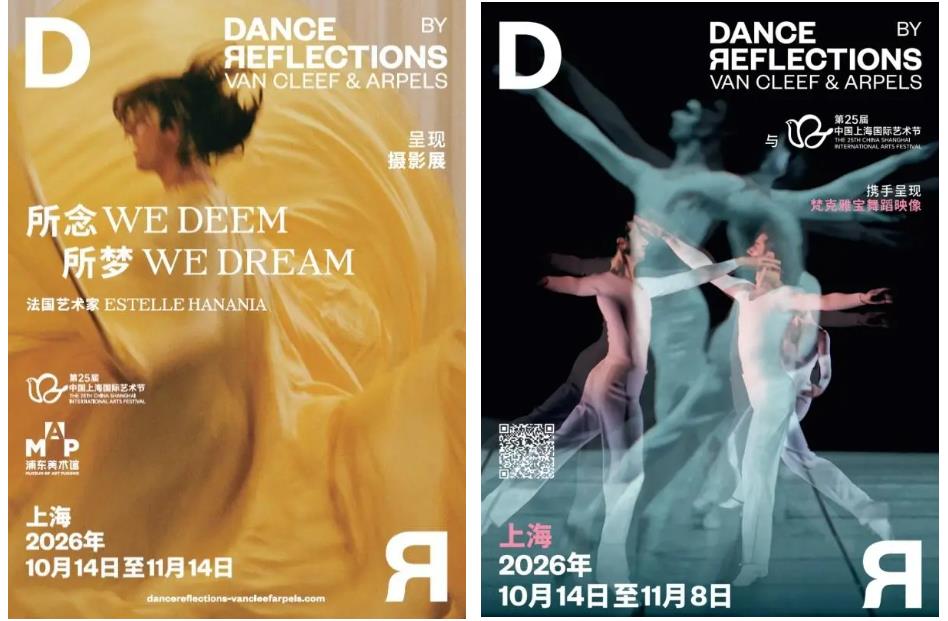
From October 14 to November 8, “Dance Reflections by Van Cleef & Arpels” partners with the China Shanghai International Arts Festival to present the first Dance Reflections by Van Cleef & Arpels Festival in Shanghai, bringing together performances by 15 dance companies from around the world in a celebration of contemporary dance. Alongside the festival, French artist Estelle Hanania, who has worked closely with Van Cleef & Arpels since 2022, presents her new photography exhibition, “We Deem We Dream”, at the Museum of Art Pudong. The exhibition runs through November 14.
Source: Museum of Art Pudong