Shanghai Weekly Bulletin (Issue 168 No.4, November 2026) ( 2026.11.25 )
Laws and Regulations
National
1. Nine Authorities Issue Guidelines to Strengthen the System for Recovering Recyclable Resources
[Keywords: Recyclable resources, Recycling system]
The Ministry of Commerce and eight other authorities recently issued the Opinions on Further Developing the Recyclable Resource Collection System and Promoting High-Quality Development of the Recycling Industry. The document sets out 16 measures in five areas: promoting recycling models, focusing on key categories of recyclable materials, improving recycling quality, developing the recycling system, and strengthening coordination.
Source: Ministry of Commerce
https://www.mofcom.gov.cn/zwgk/zcfb/art/2026/art_72d1146585b84058a5b609ed0af70da9.html
2. Two Authorities Jointly Issue Plan to Upgrade Light Industry Through Higher Standards
[Keywords: Standards, Light industry]
The Ministry of Industry and Information Technology (MIIT) and the State Administration for Market Regulation recently issued the Implementation Plan for Using Higher Standards to Guide the Improvement and Upgrading of Light Industry. The document sets out six major actions to improve the standards system and raise quality, establish a foundation through mandatory national standards, use standards to support digital and intelligent transformation, use standards to guide green and low-carbon development, adapt standards to the needs of seniors and young children, and advance the internationalization of standards. It breaks these actions down into 12 specific tasks and four projects and strengthens tailored guidance on standardization across key light industry subsectors.
Source: MIIT WeChat Official Account
3. Implementation Plan for New-Type Energy Storage During the 15th Five-Year Plan Period Issued
[Keywords: New-type energy storage]
The National Development and Reform Commission (NDRC) and the National Energy Administration recently issued the Implementation Plan for New-Type Energy Storage During the 15th Five-Year Plan Period. The document calls for developing a range of applications for new-type energy storage and supporting technological innovation and research to address key technical challenges. It aims for the sector to transition from large-scale development to market-driven development by 2030, with nationwide installed capacity reaching 300 million kilowatts and an average storage duration of around three hours.
Source: NDRC
4. MIIT Announces Eight Pilot Regions for 6G Innovation and Development
[Keywords: 6G, Ministry-provincial collaborative pilot program for innovation and development]
The MIIT recently issued written replies approving eight provinces and municipalities to participate in a pilot program for collaboration between the ministry and provincial-level governments on 6G innovation and development. The participants are Beijing, Hebei, Shanghai, Jiangsu, Zhejiang, Anhui, Hubei, and Guangdong. The program aims to pool their strengths and resources, strengthen joint innovation with the ministry, and coordinate efforts to advance 6G technological innovation, develop the industry, and foster new applications.
Source: International Services Shanghai
https://english.shanghai.gov.cn/en-Latest-WhatsNew/20261119/efc83b1d6b0b45298d54d6e01a98068b.html
Shanghai
1. Shanghai Issues New Rules on Scientific Data Management
[Keywords: Scientific data]
The Shanghai Municipal Commission of Science and Technology and the Shanghai Data Bureau recently issued the Measures of Shanghai Municipality for the Management of Scientific Data (for Trial Implementation). The document sets out responsibilities for managing scientific data and establishes provisions on building and preserving data resources, developing, using, and openly sharing data, ensuring confidentiality and security, and conducting assessments and providing support. The document took effect on November 1, 2026, and will remain valid through October 31, 2028.
Source: Shanghai Municipal Commission of Science and Technology
https://stcsm.sh.gov.cn/zwgk/kjzc/zcwj/kwzcxwj/20261113/110dc7257e8b4ca485a9ad10ca1fed9a.html
2. Two Authorities Issue Guidance to Enhance Services in Shanghai’s Banking and Insurance Sectors
[Keywords: Banking, Insurance, Green finance]
The Shanghai Bureau of the National Financial Regulatory Administration and the Shanghai Branch of the People’s Bank of China recently issued the Notice on Enhancing Service Capabilities in Shanghai’s Banking and Insurance Sectors and Promoting the High-Quality Development of Green Finance. The document calls on Shanghai’s banking and insurance sectors to build a systematic framework for delivering targeted, diversified, and specialized green finance services on a regular basis. It aims to enhance the sectors’ service capabilities and support Shanghai’s development as an international green finance hub.
Source: Official WeChat Account of NFRA Shanghai Bureau
3. Shanghai Issues Measures to Promote High-Quality Development of Cultural and Creative Industry Parks
[Keyword: Industrial parks]
The Office of the Shanghai Cultural and Creative Industry Promotion Leading Group and four other authorities recently issued the Shanghai Municipal Measures to Promote the High-Quality Development of Cultural and Creative Industry Parks. The document focuses on developing a corridor of cultural and creative industry clusters along the “One River, One Creek” waterfront, integrating culture, commerce, tourism, sports, and exhibitions, strengthening business incubation in the parks, and creating new consumer experiences. It provides for loan interest subsidies, the development of standards, and tiered cultivation to help the parks improve their quality and upgrade through urban renewal.
Source: Shanghai Release
Q&A
An official from the Ministry of Commerce answers media questions at a State Council Information Office press conference on efforts to further develop the recyclable resource collection system
Q
As China’s new energy industry grows rapidly, the collection and treatment of solid waste from the “new trio”, including spent traction batteries, photovoltaic modules, and wind turbine blades, are drawing increasing attention. What measures does the Opinions on Further Developing the Recyclable Resource Collection System and Promoting High-Quality Development of the Recycling Industry set out to improve the system for collecting and recycling solid waste from the “new trio”?
A
In China, traction batteries used in new energy vehicles are now beginning to reach the end of their service life in large numbers. Photovoltaic modules and wind turbine blades will reach their respective retirement peaks in succession. In recent years, the system for collecting and recycling solid waste from the “new trio” has begun to take shape, the basic policy framework is in place, and implementation mechanisms have gradually improved. However, collection and recycling efforts still focus primarily on “end-of-pipe treatment”, gaps remain along the chain from production to reuse, and the relevant technologies are still immature.
To address these issues, the Opinions devotes a chapter to the collection and recycling of solid waste from the “new trio.” In the near term, efforts will focus on addressing the industry’s most pressing problems and closing gaps in implementation. Over the medium to long term, the aim is to ensure that the entire chain runs smoothly, from design, manufacturing, and use through collection, dismantling, and reuse. The measures cover three areas.
First, we will collect all types of traction batteries. To this end, we will establish a system of digital IDs for traction batteries used in new energy vehicles and extend producer responsibility. We will also revise the requirements for the comprehensive utilization of spent traction batteries from new energy vehicles and promote the scrapping, collection, and dismantling of these vehicles and their batteries as a unit. At the same time, we will step up the development and adoption of new collection and dismantling technologies and move faster to close gaps in collection systems for non-automotive power batteries, energy storage batteries, and consumer batteries. Through these measures, we will ensure that all types of traction batteries can be traced when retired and collected in an orderly manner.
Second, we will manage wind and solar power equipment throughout its life cycle. We will improve the policy framework by developing guidelines on the comprehensive utilization of wind power components and drawing up measures to govern the collection and treatment of retired wind turbine blades and photovoltaic modules. We will also strengthen collection mechanisms by implementing requirements for the disposal of end-of-life photovoltaic modules and wind turbine blades and encouraging power generation companies to establish systems for collecting and recycling retired equipment. In addition, we will promote business partnerships by exploring ways for centrally administered state-owned power companies to connect with companies specializing in comprehensive utilization through market-based mechanisms.
Third, we will step up efforts to plan investment and advance research and development. To this end, we will guide large centrally administered state-owned enterprises in investing in collection networks and recycling facilities based on where new energy industries are located, further improving the layout of the collection network. We will also guide key enterprises in making breakthroughs in key technologies needed across the industry and promoting the use of advanced technologies and equipment, including AI, so that retired equipment can be collected and properly dismantled.
Through these measures, we aim to build by 2030 a comprehensive, orderly, and technologically advanced system for collecting and recycling solid waste from the “new trio” that operates in line with established standards. We also aim to improve collection, dismantling, and reuse across the board.
Source: State Council Information Office
http://www.scio.gov.cn/live/2026/39914/tw/
Expert Perspective
The Era of Specialized Legislation on Cross-Border Corruption Has Arrived: An Analysis of Ten Key Issues in the Law on Combating Cross-Border Corruption (Part II)
By Liu Xinyu and Chen Runping [Zhong Lun Law Firm]
[Article Overview]
This article continues its analysis of key issues under the Law on Combating Cross-Border Corruption, focusing on how the law defines cross-border corruption and what it requires of enterprises in terms of integrity and compliance. It outlines five categories of conduct covered by the law: (1) bribery of foreign public officials or officials of public international organizations, (2) bribery of public officials and other persons in China by overseas parties and the related acceptance of bribes, (3) duty-related violations and crimes committed abroad by domestic parties, (4) other similar acts of corruption committed abroad or producing effects in China, and (5) the flight abroad of individuals involved in corruption and the cross-border transfer of assets linked to corruption.
The article summarizes corporate compliance requirements in five areas: compliance policies and organizational structures, integrity risk assessments and internal reporting, financial and accounting controls, third-party management, and employee education and training. It notes that enterprises that fail to meet these obligations and refuse to take corrective action after being ordered to do so may face measures such as suspension of the relevant business activities, suspension of operations pending corrective action, or revocation of the relevant business licenses. The article offers guidance to enterprises engaged in cross-border business operations on improving their compliance systems.
[Article Details]
II. Definition of Conduct: What Conduct Constitutes Cross-Border Corruption?
The law provides a systematic definition of “cross-border corruption” by specifying categories of conduct and including a catch-all provision. It covers the following five categories.
Outbound bribery. This category covers bribery of foreign public officials or officials of public international organizations by Chinese citizens, domestic entities, and the branches and subsidiaries of those entities. It also covers the same conduct when carried out in China by overseas entities. In the first case, jurisdiction is based on the nationality principle and extends to overseas branches and subsidiaries. In the second case, the principle of territorial jurisdiction applies. If the bribery occurs in China, China has the authority to exercise jurisdiction even if both the bribe giver and the recipient have foreign connections.
Inbound bribery and related acceptance of bribes. This category covers bribery by foreign individuals, enterprises, other organizations and their branches to domestic public officials and persons with specified ties to those officials, or to state organs, state-owned enterprises, public institutions and people’s organizations. It also covers the related acceptance of bribes. The law gives equal weight to the giving and acceptance of bribes and focuses on emerging patterns of corruption, such as schemes in which foreign investors target officials, favors are secured in China, and payments are received abroad.
Duty-related violations and crimes committed abroad by domestic parties. This category covers duty-related violations and crimes committed abroad by Chinese citizens, domestic entities, and the branches and subsidiaries of those entities. Examples include embezzlement and bribery, abuse of power, dereliction of duty, rent-seeking through the exercise of official power, improper transfers of benefits, malpractice for personal gain, and waste of state funds and assets. This provision is consistent with the nationality principle set out in Article 7 of the Criminal Law.
Other similar acts of corruption. This category covers other similar acts of corruption committed wholly or partly abroad whose consequences occur wholly or partly in China. This catch-all provision uses the places where the conduct occurs and where its consequences arise as jurisdictional links, giving authorities flexibility to address the varied and complex forms that cross-border corruption takes in practice.
Flight abroad and cross-border transfers of assets. This category covers cases in which individuals suspected of corruption flee abroad or transfer assets linked to corruption across borders. By defining these acts themselves as cross-border corruption, the law provides a more direct legal basis for applying measures to prevent flight and block asset transfers.
III. Compliance Obligations: What Statutory Duties Must Enterprises Fulfill?
The law’s integrity and compliance provisions warrant particular attention from enterprises engaged in cross-border business operations. This is the first time China has used dedicated legislation to systematically set out the integrity and compliance obligations of these enterprises. By elevating compliance requirements from guidance to statutory obligations, the law makes them substantially more binding.
The law establishes a comprehensive framework for corporate integrity and compliance obligations built on five pillars.
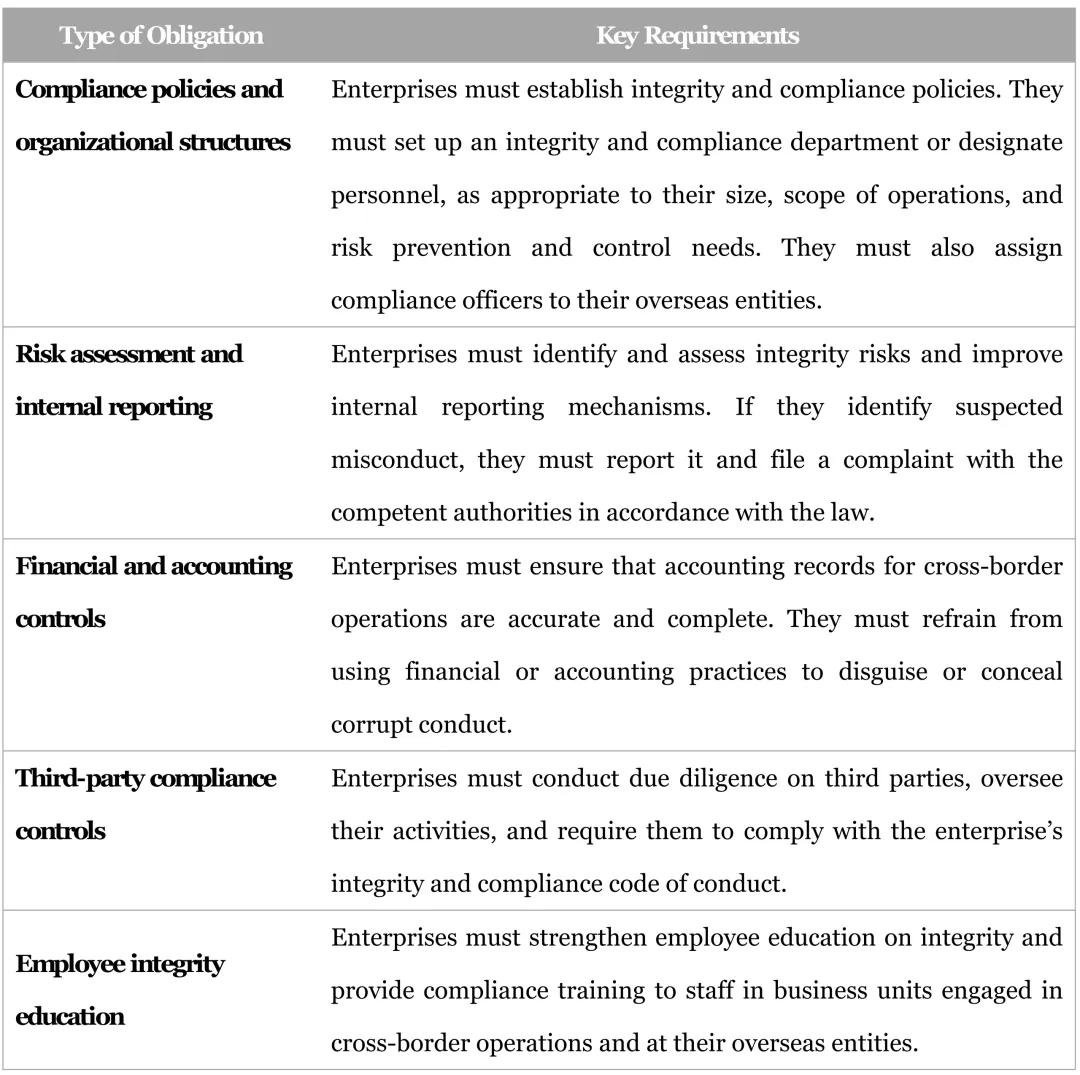
Institutional Breakthrough: Noncompliance as an Independent Ground for Administrative Penalties
Under the law, enterprises that fail to fulfill their integrity and compliance obligations are ordered to take corrective action within a specified period. If they refuse to do so, they may be ordered to suspend the relevant business activities or suspend operations pending corrective action, or they may have the relevant business licenses revoked.
The breakthrough of this regulation lies in the fact that violating the obligation of integrity and compliance constitutes an independent administrative violation, without the premise that actual corruption has occurred. An enterprise may therefore face administrative penalties solely because its compliance system falls short of statutory requirements, even in the absence of any corrupt conduct.
[To Be Continued]
One Week in Shanghai
Latest News
1. 7th Meeting of the Singapore-Shanghai Comprehensive Cooperation Council Held in Shanghai
[Keyword: Singapore-Shanghai Comprehensive Cooperation Council]
Recently, the 7th meeting of the Singapore-Shanghai Comprehensive Cooperation Council took place in Shanghai and included a ceremony to sign cooperation agreements and announce related outcomes. Relevant government departments, institutions, and companies from Shanghai and Singapore signed cooperation documents for 16 projects in areas including joint development under the Belt and Road Initiative, financial cooperation, scientific and technological innovation, the digital economy, urban governance, and cultural and people-to-people exchanges.
Source: Shanghai Release
2. Certification Ceremony Held for 43rd Batch of Multinational Corporations’ Regional Headquarters and R&D Centers
[Keywords: Multinational corporations, Regional headquarters, R&D centers]
At a recent certification ceremony for the 43rd batch, 30 regional headquarters of multinational corporations and 15 foreign-funded R&D centers received certificates. The recipients are concentrated in Shanghai’s priority industries, including biomedicine, automotive, high-end equipment, advanced materials, fashion consumer goods, and electronic information.
Source: Shanghai Release
3. International Chamber of Commerce (ICC) to Establish Case Management Office in Shanghai
[Keywords: ICC]
The International Chamber of Commerce (ICC) and the Shanghai Municipal People’s Government recently signed an agreement paving the way for the ICC International Court of Arbitration to establish a case management office in Shanghai. ICC’s Shanghai case management office is expected to begin operations in the first half of 2027. The office will play an important role in bringing more commercial disputes with a foreign element to Shanghai for resolution and strengthening the city’s cross-border dispute resolution framework. Its establishment marks a milestone in Shanghai’s efforts to strengthen the rule of law in foreign-related matters and develop into an Asia-Pacific center for international commercial dispute resolution.
Source: China (Shanghai) Pilot Free Trade Zone
4. Shanghai Climbs to No. 2 in Latest Global Maritime City Rankings
[Keywords: Leading maritime cities]
The 2026 edition of The Leading Maritime Cities of the World, recently released jointly by Norway’s DNV and Menon Economics, shows that Shanghai rose from fourth place in 2024 to second globally. Shanghai moved up in three categories: maritime technology, shipping centers, and ports and logistics. Its ranking in maritime technology jumped from fourth to first.
Source: International Services Shanghai
https://english.shanghai.gov.cn/en-Latest-WhatsNew/20261118/844afdc5f40d4f3f90b379f2373c314b.html
5. 2026 Edition of the Shanghai Guidebook for Overseas Asset Manager Released
[Keywords: Overseas asset managers, Shanghai, Investment]
The 2026 edition of the Shanghai Guidebook for Overseas Asset Manager was recently released. The document highlights four developments: broader market access, clearer rules and greater predictability, Shanghai’s stronger capabilities as an international financial center, and a better-structured fund ecosystem in Shanghai.
Source: International Services Shanghai
https://english.shanghai.gov.cn/en-OptimizedBizEnvironmentforFinancialSector/20261113/912f127cfe074cdda6c0ada32dadafbb.html
Corporate Activities
1. Roche Completes Infrastructure Construction at Shanghai Biopharmaceutical Manufacturing Base
[Keyword: Roche]
Roche recently announced that it had completed infrastructure construction at its RMB 2.04 billion biopharmaceutical manufacturing base in Shanghai, marking a milestone in its efforts to localize production in China. The company also announced that it would establish a China Early Development Center of Excellence (CED CoE) for pharmaceuticals in Shanghai’s Pudong and set up Roche (Beijing) Pharmaceuticals Co., Ltd.
Source: Pudong Release
2. Henkel Adhesive Technologies Opens Application R&D Center in Shanghai
[Keyword: Henkel]
Recently, Henkel Adhesive Technologies inaugurated its Consumer & Construction Application R&D Centre in Shanghai. Built to high standards and staffed by a team of researchers with doctorates, the center focuses on researching and testing product applications in home furnishings, home improvement, and construction. It will provide customers in China and across Asia with first-rate product innovation and application development services.
Source: Shanghai Chemical Industry Park
Forums and Exhibitions
2026 International Data Economy Industry Cooperation Conference to Open on November 26
[Keywords: International Data Economy Industry Cooperation Conference]
The 2026 International Data Economy Industry Cooperation Conference (IDEICC) will be held at the Lingang Center in Shanghai on November 26. Under the theme “Taking AI Global, Connecting the World Through Data”, the conference will bring together representatives of international organizations, research institutions and industry associations from China and abroad, and companies in fields such as artificial intelligence, smart vehicles, digital culture, and data technology. Participants will explore practical ways to bring AI services to global markets and expand opportunities for international cooperation in the data economy.
Source: Shanghai Lingang
Competition Events
1. F1 Academy Announces 2027 Race Calendar, with Shanghai Round Set for April 16 to 18
[Keyword: F1]

F1 Academy has announced its 2027 race calendar. Shanghai will host the second round from April 16 to 18, 2027, alongside the 2027 Formula 1 Heineken Chinese Grand Prix at the Shanghai International Circuit.
Source: International Services Shanghai
https://english.shanghai.gov.cn/en-Latest-WhatsNew/20261116/0870333515124f9a8a170bf35219174a.html
2. Shanghai Leg of the 2026-27 ISU Short Track World Tour to Open on November 27
[Keywords: ISU Short Track World Tour Shanghai leg]
The Shanghai leg of the ISU Short Track World Tour for the 2026-27 season will take place at the SPD Bank Oriental Sports Center from November 27 to 29. A total of nine gold medals will be awarded across six individual events (the men’s and women’s 500, 1,000, and 1,500 meters) and three relay events (the women’s 3,000-meter relay, the men’s 5,000-meter relay, and the 2,000-meter mixed team relay).
Source: International Services Shanghai
https://english.shanghai.gov.cn/en-SportsEvents/20261023/9dfb6614b78f49cda812aa4f40a7829d.html
3. National Finals of the 11th “Maker in China” SME Innovation and Entrepreneurship Competition to Open Soon
[Keywords: Maker in China]
The national finals of the 11th “Maker in China” SME Innovation and Entrepreneurship Competition will be held on Fuxing Island in Shanghai’s Yangpu District from November 25 to 27, 2026. The competition has two categories, one for enterprises and one for startups. Entries cover key fields such as integrated circuits, intelligent manufacturing, digital cultural and creative industries, biomedicine, next-generation information technology, and green and low-carbon development.
Source: Maker in China Headlines
Culture & Arts
1. “Exhibition of Prints From Shanghai Library’s Rare Books Collection” Opens
[Keyword: Prints from ancient books]

Shanghai Library’s 2026 exhibition of highlights from its holdings, “Exhibition of Prints From Shanghai Library’s Rare Books Collection”, recently opened at Shanghai Library East. The exhibition brings together 138 woodblock prints from ancient books in the library’s collection. Dating from the Five Dynasties period to the mid-Qing dynasty, the exhibits are valuable as cultural artifacts, historical records, and works of art. Many of the books are on public display for the first time. For 13 of the books on display, Shanghai Library holds the only surviving copy or the only complete copy.
Source: Shanghai Library
2. Damien Hirst’s First Exhibition in China to Open in Shanghai
[Keywords: Damien Hirst]

Make | Believe, contemporary artist Damien Hirst’s first exhibition in China, will open at the Museum of Art Pudong on December 16. The major solo exhibition will bring together nearly 100 representative works from several key series, offering a panoramic view of Hirst’s career from 1986 to the present.
Source: Shanghai Tourism